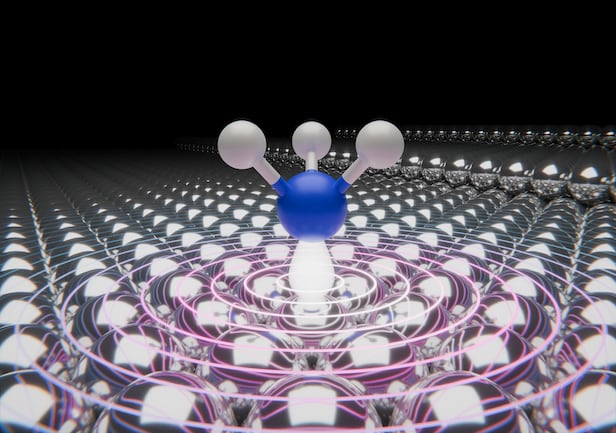
A domestic research team has found that even atomic structures far from the surface of a metal catalyst affect the strength of chemical bonds. Previously, atoms around the molecule that directly touch it were considered the main factor determining bond strength.
The Ministry of Science and ICT said on the 29th that a joint team from the Institute for Basic Science (IBS) Center for Quantum Nanoscience and Germany's Max Planck Institute for Multidisciplinary Sciences has identified a new principle of chemical bonding in metal catalysts. The findings were published in the international journal Science on the 30th.
Metal catalysts are substances that help speed up chemical reactions and are used in the production of chemical products and fuels. How strongly molecules stick to a catalyst surface is an important factor that determines the efficiency of a chemical reaction.
The researchers fabricated a platinum surface with atoms arranged like steps and compared the bond strengths of ammonia, carbon monoxide and nitric oxide molecules. They found that even when the structure at the adsorption site was similar, bond strength varied depending on the distance to nearby atomic steps.
This effect was observed at distances of about 4–7 nm (nanometers; one-billionth of a meter), depending on the type of molecule. The binding energy differed by up to about 0.2 electron volts (eV).
The team analyzed that electrons widely distributed inside the metal cause this phenomenon. When a molecule bonds to a metal surface, not only immediately adjacent atoms but also distant atomic structures can exert influence through electrons.
To explain this, they proposed a new theoretical model that considers both the properties of the molecule and the electrons inside the metal. Because each molecule has different characteristics of electronic states, it interacts with different electronic states within the metal, which explains why long-range effects vary by molecule even on the same metal surface.
Dmitriy Borodin, group leader at the IBS Center for Quantum Nanoscience, said, "Catalyst development is now moving away from lengthy experiments and trial and error toward predicting and designing desired properties based on the principles of chemical reactions," adding, "We expect this study to contribute to efficient catalyst design."
References
Science (2026), DOI: https://doi.org/10.1126/science.aei5255


