Attention is focusing on why chicken franchise BBQ recently opened company-operated stores in NongHyup Hanaro Mart. When a franchise headquarters, which must consider franchisees' business rights and sales, builds a separate sales network to sell chicken directly, it can risk triggering sales competition with existing owners.
Despite this burden, the reason companies are looking beyond their franchisees lies in the saturation of Korea's chicken franchise market. As it has become difficult to expect further growth through new franchise openings alone, companies are leveraging brand recognition and product development capabilities to expand sales into external channels such as big-box supermarkets, convenience stores, and online malls. In the process, they are focusing on minimizing conflicts of interest by differentiating product lineups and sales methods from franchise stores.

According to the industry on the 26th, BBQ opened company-operated stores this month at the Gyeonggi Seongnam and Goyang locations of NongHyup Hanaro Mart. It is a model where chicken is cooked and sold on-site in "OK! COOK," Hanaro Mart's in-house deli (fresh-cooked) section. The lineup includes 10 types of boneless fried and seasoned gangjeong and Jamaica sauce-flavored gangjeong, 3 side dishes, and even old-style whole chicken, for a total of 14 items.
BBQ had already been selling frozen chicken home meal replacement (HMR) products at big-box supermarkets such as Lotte Mart. This time, however, it went a step further than supplying finished goods to distributors by trying a model of operating stores directly inside the mart. A BBQ official said, "We created a new sales touchpoint so that consumers who did not plan to order chicken or visit a franchise store can purchase BBQ products while grocery shopping," adding, "We will review operating results and consider additional openings."
The backdrop for chicken franchises looking beyond existing franchise stores is the saturation of the domestic market. According to the latest statistics from the Ministry of Data and Statistics (MODS), the number of chicken franchise outlets nationwide reached 31,397 in 2024, up 5.3% from a year earlier, but sales per franchise came to 279.6 million won, an increase of only 1.9%. Compared with the pace of outlet growth, sales growth at individual stores is limited.
In response, companies are expanding into external distribution channels such as home shopping, convenience stores, and big-box supermarkets by leveraging the brand recognition and product development capabilities they have built through existing franchise stores. The aim is to secure additional revenue through product sales without increasing the number of outlets.

BBQ is one of the companies that moved relatively early to develop such external channels. In 2018 it partnered with 7-Eleven to start selling chicken in convenience stores, and in 2019 it began selling frozen chicken HMR through CJ OnStyle. It has since expanded its supply to online malls and big-box supermarkets. In Aug., it additionally placed two flavors—herb salt and Jamaica—of the "oven-grilled chicken thigh" previously sold online into Lotte Mart.
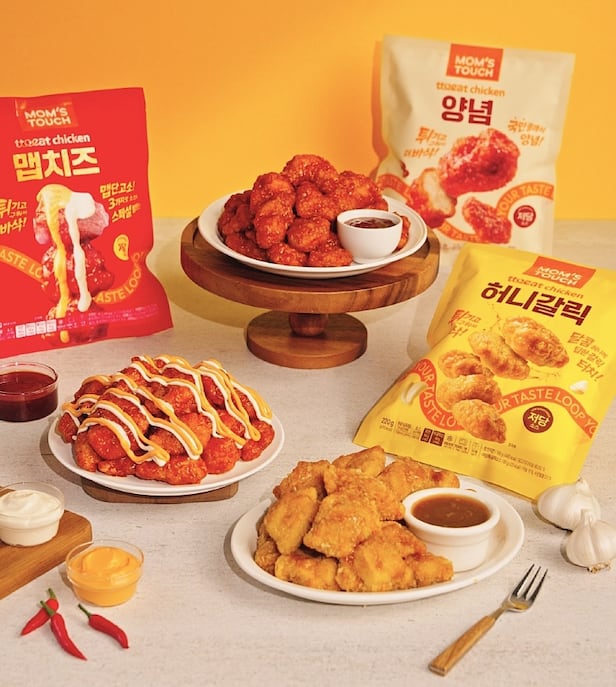
Other companies are also speeding up efforts to secure new revenue sources outside franchise stores. Mom's Touch in Apr. unveiled the HMR line "TO EAT" and launched three frozen chicken items—"Map Cheese," "Yangnyeom," and "Honey Garlic"—on Kurly. Targeted at single-person households, they are small-pack products featuring low-sugar sauces. The company plans to expand sales to offline channels such as big-box supermarkets and convenience stores.
GN Food, operator of Goobne Chicken, sells chicken breast and chicken thigh HMRs on its HMR specialty mall "Goobne Mall," along with rice dishes such as chibap and fried rice using sauces from its signature menu items "Volcano" and "Galbi King." bhc also collaborated with CU last year to release burritos and pizza using "Bburinkle" seasoning, followed by triangle kimbap and kimbap featuring the "Machoking" sauce.
These off-franchise businesses are translating into actual sales volume and revenue growth. BBQ's HMR distribution revenue in the first half of this year rose 29.3% from a year earlier. In the first quarter, related revenue nearly doubled, and the number of items handled increased 56.3%.
Goobne Mall's "chibap & fried rice" series surpassed a cumulative 12 million packs sold in May this year, with more than 1 million packs sold last year alone. bhc's four HMR items in collaboration with CU also exceeded 1 million in cumulative sales.
However, expanding external distribution by franchise headquarters carries the burden of potentially clashing with existing franchise owners' interests. If consumers buy relatively cheaper products at supermarkets or convenience stores instead of ordering chicken from franchise stores, existing outlets' sales may decline. In fact, when BBQ pursued convenience store chicken sales with 7-Eleven in 2018, some franchise owners pushed back the following year, raising concerns about possible encroachment on their business areas.
In response, companies are differentiating product lineups and sales methods from existing franchise stores. Mom's Touch said it would apply HMR-specific product specifications to "TO EAT" and differentiate sales channels by focusing on online.
BBQ is also selling separate menus such as gangjeong items and old-style whole chicken at Hanaro Mart deli counters instead of franchise staples like Golden Olive Chicken. Most products are priced under 10,000 won, and only in-store mart shoppers are targeted, with no delivery. A BBQ official said, "We minimized the possibility of sales cannibalization by distinguishing product lineups and consumer usage from regular franchise stores."