Korean listed companies have approved more than 100 trillion won in share buybacks this year, but less than half of that total explicitly earmarks the shares for cancellation.
A major reason is that Samsung Electronics allocated all 28 trillion won of this year's planned buybacks for employee compensation. The market is warning that buyback size alone should not be the yardstick for shareholder returns.
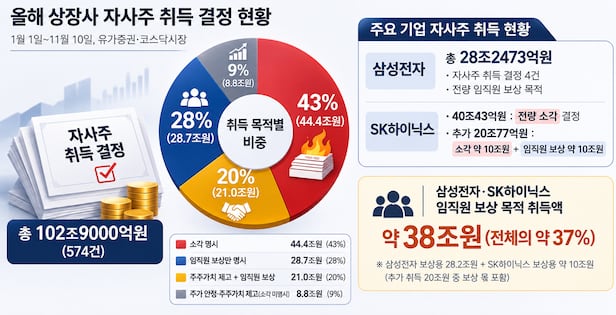
As of the 10th, from Jan. 1 to today, companies listed on the main board and KOSDAQ reported 574 decisions to buy treasury shares (including trust contracts), totaling 102.9 trillion won, according to the securities industry.
Direct purchases accounted for 263 cases (97.3 trillion won) and trust contracts 311 cases (5.6 trillion won). By market, the main board made up most of the total at 101.6 trillion won.
◇ This year, 43% of buybacks are for cancellation; Samsung and SK set aside 38 trillion won for compensation
By stated purpose in disclosures, 109 cases totaling 44.4 trillion won, or 43%, explicitly targeted cancellation. Purchases dedicated solely to employee compensation came to 28.7 trillion won (28%), followed by 21 trillion won (20%) that cited both shareholder value and employee compensation. Another 8.8 trillion won (9%) mentioned share-price stabilization or shareholder value but did not disclose whether the shares would be canceled.
Samsung Electronics accounted for most buybacks for employee compensation. The company approved four buybacks this year—Jan. 7 (2.5002 trillion won), Jan. 28 (3.5728 trillion won), Mar. 18 (7.1743 trillion won), and Aug. 21 (15 trillion won)—totaling 28.2473 trillion won. All four cited "employee stock compensation" as the purpose.
Separately, in March, Samsung Electronics' board voted to cancel 73,359,314 shares in treasury stock (5.3455 trillion won) that it already held.
SK hynix on Aug. 19 approved a 40 trillion won buyback "to enhance shareholder value through cancellation," and bought 23,693,272 common shares for 40.0043 trillion won.
On the 28th of last month, it approved an additional 20.0077 trillion won purchase. Of that, about 10 trillion won will be canceled to boost shareholder value, and the remaining roughly 10 trillion won will be used for employee bonuses and the like. The company said the 10 trillion won in buybacks for employee compensation will not count toward shareholder returns of 100 trillion won for the current fiscal year.
Adding the portion of SK hynix's additional purchase slated for cancellation (about 10 trillion won) lifts this year's total cancellation-targeted buybacks by listed companies to about 54 trillion won (53% of total approved purchases). Even so, Samsung Electronics and SK hynix together have roughly 38 trillion won in buybacks earmarked for employee compensation.
Brokerage officials say buybacks for employee compensation are hard to count as full-fledged shareholder returns. Canceling repurchased shares reduces shares outstanding and can raise the value of existing holdings, but using them for compensation pays the shares to employees, putting them back into circulation.
Some also say buybacks for compensation are not necessarily bad for existing shareholders. Without treasury shares, companies must issue new stock for compensation, which increases shares outstanding and dilutes value. Using existing treasury shares can prevent additional dilution from new issuance.
◇ Cancellations decided: 93.6 trillion won; half from previously held treasury stock
This year, companies approved 559 cancellations of treasury shares totaling 93.6 trillion won. Of those, 514 cases (45.9 trillion won) involved clearing out treasury shares bought in the past. Forty-five cases, worth 47.7 trillion won, involved canceling shares newly purchased this year.
There can be an administrative lag between a cancellation announcement and the actual reduction in shares outstanding. SK hynix disclosed Nov. 5 as the scheduled cancellation date for all shares it bought, but as of today no change-of-listing entry reflecting the completed cancellation was found on the Korea Exchange (KRX) disclosure system KIND or on DART.
An SK hynix official said, "We completed cancellation of the 40 trillion won in treasury shares acquired this year on the scheduled date, the 5th," adding, "Publicly viewable share counts are updated after the exchange completes the change-of-listing process." Once the change is done, SK hynix's total shares outstanding will fall from 730,492,365 to 706,799,093.
In some cases, execution diverged sharply from approvals. S-1 on the 14th of last month approved a 450 billion won tender offer for treasury shares, but with tenders short of the 4,545,454-share target, it bought only 1,304,797 shares (129.1749 billion won). That is a 28.7% execution rate against the target amount. S-1 plans to cancel the acquired shares within a year.
More companies are strengthening shareholder returns by canceling all treasury shares they hold. Hyundai G.F Holdings on the 6th decided to cancel 7,409,861 treasury shares—4.04% of shares outstanding—on the 20th of this month, with a book value of about 100.1 billion won. KTcs the same day decided to cancel 3,465,721 treasury shares (8.37%, about 8.66 billion won) on the 21st of next month.
Experts say whether companies ultimately carry out cancellations is key to making buybacks lift shareholder value in practice. Amendments to the Commercial Act passed the National Assembly in February, requiring companies in principle to cancel treasury shares within one year of acquisition. To hold them for employee compensation and other reasons, companies must draw up a disposal plan and win approval at the shareholders meeting each year.
Jeong Seokho, CEO of Korea Proxy Advisory, said, "With cancellation effectively mandated under the amended Commercial Act, the current law is drafted on the premise of cancellation," adding, "Shareholder returns are real only when cancellation is carried through to the end."
Jeong added, "Buying treasury shares for employee compensation merely changes who holds the shares, from investors to employees. That purpose from the outset is not shareholder returns."